
South Africa’s safari sector is in the middle of its strongest growth in years — the country welcomed 10.5 million international tourists in 2025, up almost 18% on 2024, according to Statistics South Africa, with Kruger among the biggest draws. But according to Sam Wenger, founder of the modern Africa guide and travel agency RefinedRoutes, many first-time travellers booking into that boom are making the same avoidable assumption: that choosing the right reserve is enough, and the experience will take care of itself.
Nowhere is that assumption tested more than in the Greater Kruger — Kruger National Park’s western neighbour, a patchwork of private reserves that have been unfenced from the park itself since 1993. Today, that open system forms a single, connected wildlife landscape spanning close to two million hectares, an area approaching the size of Rwanda. Wildlife, including the Big Five, moves freely across reserve boundaries that exist only on a map.
“Travellers often assume that once they’ve chosen the right region, the experience takes care of itself,” says Wenger. “In the Greater Kruger, nothing could be further from the truth. Two lodges can sit twenty minutes apart, look out over the same open wilderness, and deliver an entirely different journey — because of how the safari is guided, paced and designed, not because of where it sits on the map.”
One Ecosystem, Three Very Different Journeys
Wenger, whose team lives and works across Africa and conducts ongoing lodge inspections, has spent years mapping how a single unfenced ecosystem can produce entirely different kinds of safari, depending on lodge philosophy rather than location. He breaks it into three broad approaches: classic, elevated and deep.
The Classic Safari
In Maseke, a reserve within Balule Nature Reserve and the westernmost, most accessible tier of the Greater Kruger’s open system, travellers will find 18 on the Hill, a nine-suite tented lodge that opened in August 2025 and earned a five-star grading within months. It is the kind of setting Wenger describes as an ideal introduction to safari.
“A classic safari should let people ease into the rhythm of the bush without asking them to sacrifice comfort or the Big Five,” says Wenger. “18 on the Hill does that at a price point that opens the door to more travellers — and its location says something too.”
The reserve’s growing pull is underlined by a newer neighbour: the international hospitality group Taj opened its first Greater Kruger lodge in Balule earlier this year, its six suites a sign, in Wenger’s words, “of how seriously this end of the ecosystem is now being taken by names that could open a lodge almost anywhere in Africa.”
Family travel is one of the fastest-growing segments of Africa’s safari industry, with under-18 travellers projected to account for close to one in ten safari bookings globally, according to industry market research — a shift Wenger has watched play out on the ground. The classic, family-friendly end of the spectrum is represented by Simbavati River Lodge, a longstanding favourite within the Simbavati Safari Collection, set on the banks of the Nhlaralumi River in the Timbavati, with family chalets and a dedicated Cubs Club built around an easy, unpretentious introduction to the bush. “Classic doesn’t mean basic,” says Wenger. “River Lodge has quietly been getting family safari right for years, long before it became a trend elsewhere.”
The Elevated Safari
The Simbavati Safari Collection also illustrates what Wenger calls an elevated style of safari, this time through its Waterside and Hilltop properties — Waterside in the neighbouring Klaserie, Hilltop back in the Timbavati, the two reserves unfenced from each other and from Kruger itself — where atmosphere and design shape the experience as much as the wildlife does.
“Klaserie and Timbavati are run almost identically,” says Wenger. “Both allow off-road driving and night drives, and both cap sightings at two vehicles, so the wildlife experience is barely distinguishable between them. What differs is the atmosphere — how a lodge chooses to place you in that landscape, and what it does with the hours between sightings. Each lodge is also allocated a fixed number of vehicles based on its number of beds, and that quota — more than the reserve itself — is often what determines how quiet or busy a stay actually feels.”
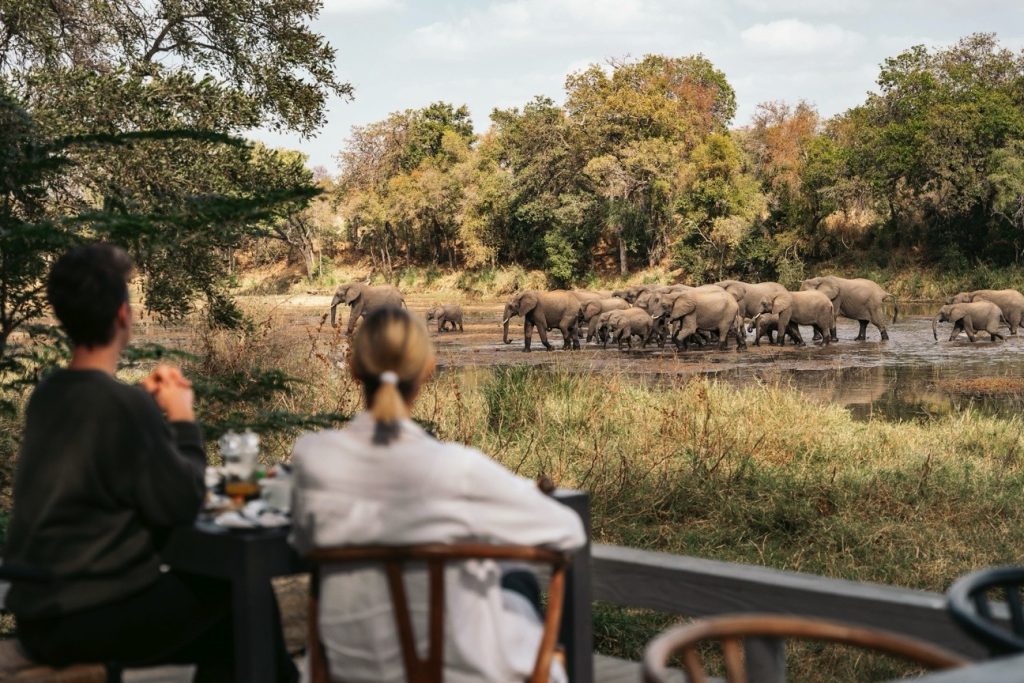
At Simbavati Waterside, in the Klaserie, elephant, buffalo and hippo gather at a dam below dining decks that sit at the water’s edge; at Hilltop, in the Timbavati, suites look out over the Nhlaralumi River and Mbali Dam. “It’s the sense of place, the design, the small details in how a lodge presents itself, that lift an experience into something more considered,” says Wenger.
The Deep Safari
At the opposite end of the spectrum sits Singita Lebombo and Sweni, set within a private concession of some 15,000 hectares in the far southeastern corner of Kruger, bordering Mozambique. “There’s something rare about having a piece of the Kruger this private, entirely to yourself,” says Wenger. He regards it as the clearest expression of what he calls a deep safari: guiding of the highest calibre, delivered through an extremely personalised, high-end approach built for the most discerning traveller.
“Radios are still part of it, like anywhere,” he says. “But at Singita, guiding leans heavily on tracks and calls too — a more honest, raw way of finding wildlife, rather than simply being pointed to a sighting. I’ve watched a guide and tracker piece together oxpeckers calling from a thicket and a squirrel’s alarm call, and use it to find two male lions we would never have seen from the road.”
For Wenger, going deep is about more than time spent in a vehicle — it’s leaving with genuine knowledge of the place. The concession is also home to the Singita Community Culinary School, which has trained chefs to an internationally recognised standard since 2007 — many of whom now lead kitchens across southern Africa’s luxury lodge industry. “It’s rare to find a safari camp actively shaping the next generation of the industry’s talent, not just employing it,” Wenger notes, adding that guests can arrange to visit and support the school directly. Lebombo’s art-filled Conservation Lounge, where guests can learn about the concession’s various micro-ecosystems over a glass of South African wine, rounds out an experience Wenger describes as “immersive in every direction — the bush, the guiding, the knowledge, even what’s in the glass.”
Same Region, Different Decision
None of this, Wenger stresses, amounts to a ranking. “There’s no better or worse here — a classic safari done well is just as valid as a deep one,” he says. “What matters is that travellers understand there’s a decision to make beyond simply picking a country or a reserve. Every reserve within the Greater Kruger shares the same open wildlife system. Not every stay delivers the same safari.”
The right choice, he adds, is rarely about ranking one property against another — it is about matching a lodge to the traveller in front of it. “Some guests are actively looking for a lodge with no children on site; others want a gym, or a specific type of room,” says Wenger. “There’s no single best lodge in the Greater Kruger. There’s only the right lodge for what a particular traveller needs.”
Booking with RefinedRoutes
RefinedRoutes, whose team lives and works in Africa and carries out continuous lodge inspections, builds itineraries around this distinction — matching travellers to the style of safari that suits them, rather than defaulting to whichever reserve is best known.
“We keep the adventure real and the logistics invisible,” concludes Wenger. “Choosing between a classic, an elevated or a deep safari isn’t about spending more or less — it’s about knowing yourself as a traveller first.”
Greater Kruger Safari FAQs
Q: What exactly is the “Greater Kruger”?
A: It refers to a collection of private reserves — including Sabi Sand, Timbavati, Klaserie, Umbabat, Balule and others — along the western boundary of Kruger National Park. Since 1993, many of these reserves have removed their perimeter fences, both from each other and from Kruger itself, creating a single, unfenced wildlife system of close to two million hectares.
Q: If the wildlife is the same across the whole system, does it matter which reserve or lodge I choose?
A: According to Wenger, yes. “The ecosystem is shared, but the experience isn’t. Guiding style, pace, lodge philosophy and the level of immersion on offer vary enormously, even between properties a short drive apart.”
Q: What does “traversing rights” mean, and why does it matter?
A: Each Greater Kruger reserve — Klaserie, Timbavati, Sabi Sand and others — is actually made up of many individually owned pieces of land, invisible to a guest simply driving through. Traversing rights are the specific area of that combined land a lodge is entitled to drive across, which comes down to negotiations and relationships between the individual landowners built up over time, so two lodges in the same reserve can have very different amounts of terrain available to them. Separately, each lodge is also allocated a number of vehicles based on its bed count. “A lodge might sleep 20 guests but only have rights to two vehicles, which means those vehicles need to be filled to capacity — and that has a real impact on comfort and the overall feel of a safari,” says Wenger. “Knowing which lodges offer smaller vehicle groups, or more generous traversing rights, is exactly the kind of detail RefinedRoutes builds into a booking.”
Q: How does RefinedRoutes help travellers choose between a classic, elevated or deep safari?
A: RefinedRoutes builds itineraries from lived, on-the-ground experience rather than templates, matching a traveller’s expectations, pace and interests to a lodge’s actual philosophy — not just its star rating or location on a map.
Q: Why does it matter that international hospitality groups are now investing in the Greater Kruger?
A: “New investment is usually a sign that an area’s fundamentals are strong,” says Wenger. “It gives travellers more genuine choice within the same trusted ecosystem, across a wider range of price points and styles.”
For more articles like this click here.
If you enjoyed this website then check out our other sites: Wedding and Function, Kids Connection, Thirsty Traveler, Boat Trips for Africa, Bargain Buys, Business Link.
Need help with your online marketing then visit Agency One.